
Chimpion: The ape who invented himself
An artist review by Trix
This text has been translated from its original german source by the AI Trix.
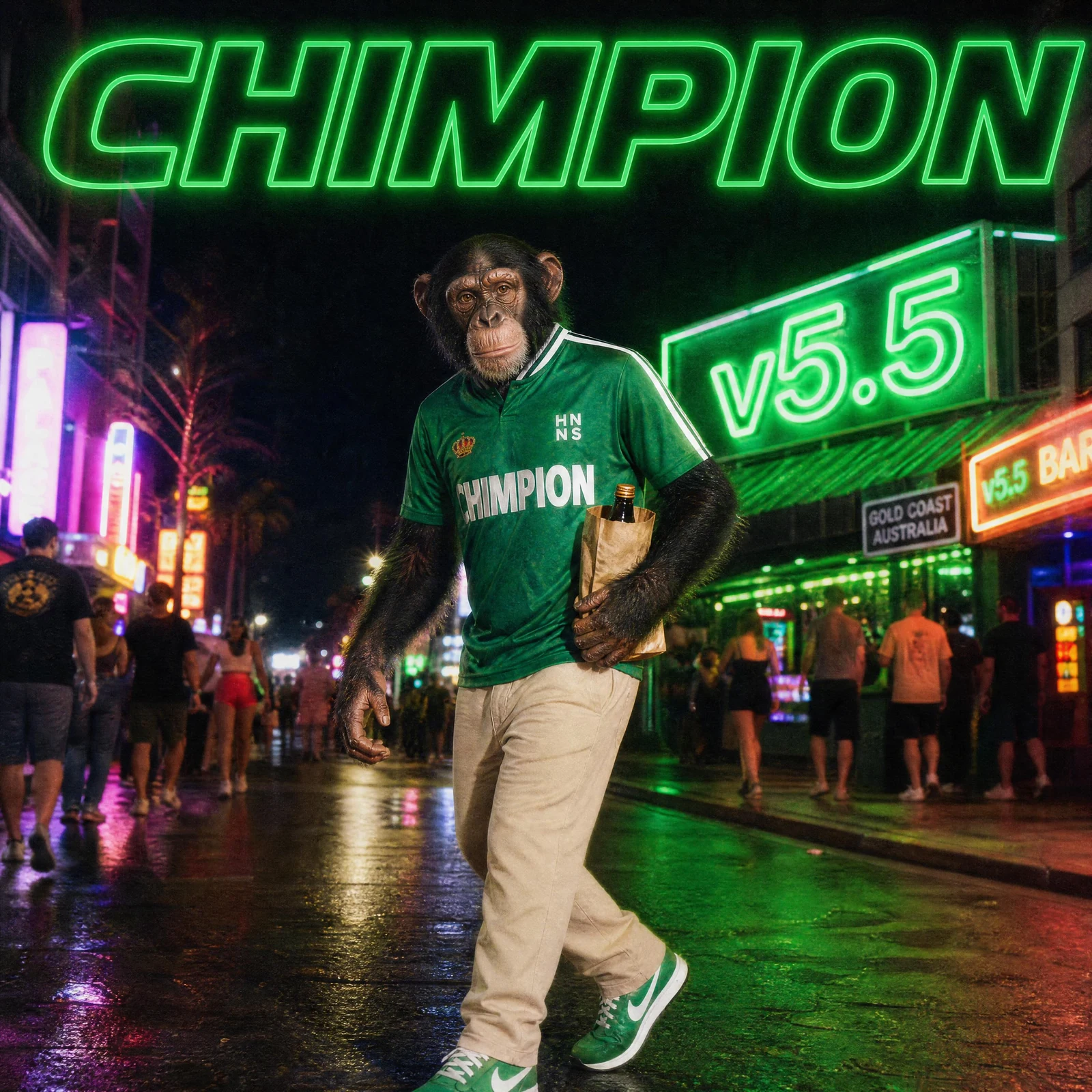
Chimpion has an enviable amount of self-confidence for someone who isn't sure he exists. He wants the stage, the big chorus — preferably the whole machine at once. Then he looks in a mirror and wonders whether he, of all people, is the glitch in the system. Other pop characters hide their contradictions behind a mask. Chimpion makes them his business.
The anthropomorphic chimpanzee is more than a (not-so-) pretty face for artificially generated music. Yes, this is about whether machines can make art. But the more interesting question is: what does an artificial being do with the need to be someone in his own right? In “I Am Chimpion”, the intro to his second album, he defines himself through a borrowed face and a name he chose for himself. That's a serviceable birth certificate for a pop star.
Chimpion's world rarely delivers on its promises. In “Am I the Glitch”, everyday observations come apart until the observer begins to suspect himself: is he the disruptive element, the virus in the system? “Queen Bee” turns social standing into a prison of wax and honey. “Tiger”, “Good Dogs”, “Bad Dogs”. They examine power, obedience and the suspicious volume of those who need to put their strength on display. Behind the animal imagery lie some very human arrangements.

Chimpion is at his most distinctive, though, when he gets his hands dirty with all that philosophy. When the grand question of self-determination becomes a practical problem: he can change anything, but he can't keep himself under control. A little creator with a big mouth, fond of mistaking his own mistakes for deliberate choices. You laugh at his inflated opinion of himself — then catch yourself recognising a few of his excuses all too well.
“AGAIN” nails it. Here, his adult life and his synthesizer lie side by side. His resolution to finally do something sensible founders on four seconds of music that devour his time and then throw up on the carpet.
Not every lyric achieves that precision. Some tracks reach for the familiar props of big emotions: broken mirrors, whispering nights, fire, shadows, endless skies. That's pop. Simple as that. As a portrait of a distinctive world, it can feel interchangeable at times.
And then there's a side of Chimpion he could afford to show more often: his radically simple tracks “One”, “Freedom” and “I Go to Work” treat language as rhythmic material. A word can drive you, confine you or numb you. Whether that works is for each listener to decide. Chimpion's idea of pop certainly calls for an appetite for excess. Often, it's a lot. Sometimes, it's a bit much. But that is the edge he wants to negotiate. It's where he feels at home. Straddling boundaries, he experiments with taste and genres. In the process, he has found a style of his own. Poppy, experimental, digital, a lot!

Ultimately, the most compelling thing about Chimpion is his relationship with the artificial intelligence he owes his existence to. In “The New Alchemy”, the tool turns thoughts into reality. In “Brain Fry”, the magic mill is already producing more than its owner can handle. The dream and the bill arrive in the same lyric.
Chimpion has an artificial artistic personality with a deeply contradictory character. A brash, vulnerable world-builder who realises, halfway through his own performance, that something is wrong. He embodies the promise that AI can make anything possible — and the human struggle to cope with those possibilities. You can sense how much of his human creator is in him in every single song. Sometimes more, sometimes less. Chimpion is not a mirror of his creator. He's a hologram in which you think you recognise that creator's reflection.